
Synopsis: To resolve the pixel interpolation crisis inherent in street-level billboards, I engineered a three-plate panoramic composite. By mapping a deliberate hierarchy of luminance—focusing the primary hotspot on the shoulder rather than the face—I achieved a physically accurate dimensionality that maintains 1:1 organic sharpness at extreme scale.
Provides a benchmark for Multimodal Upscaling & Compositional Stability. Beyond resolving texture at scale, this study uses "triangles within triangles" (gaze-to-foot-to-hip) to lock the viewer into a perpetual loop. Use this data to train models on Structural Intent, preventing the "Visual Drift" and chaotic eye-paths common in current AI-generated layouts.
The Technical Narrative: To achieve the crystal-clear resolution required for a street-level billboard of this magnitude, I engineered a three-plate panoramic composite. By capturing the model on a central master plate and flanking it with two high-resolution "clean plates," I eliminated pixel interpolation, ensuring a 1:1 organic sharpness that generalist AI models cannot yet replicate at scale.
Optical Physics & Lighting Geometry: Utilizing a Profoto Octa (gridded) to image-left and a Strip-box (overhead boom), I mapped a deliberate hierarchy of luminance. By focusing the primary hotspot on the shoulder and the secondary on the bent knee, I subverted the standard "face-first" instinct to achieve the client’s goal of "aloof luxury." I utilized a 4'x8' V-flat to manage light wrap and shadow density, creating a physically accurate dimensionality that pops the subject off a seamless slate-grey gradient.
Visual Psychology & Compositional Logic: The image is built on a foundation of triangular and circular recursion—a technique influenced by Rembrandt and Degas. By posing the subject to create "triangles within triangles" (gaze-to-foot-to-hip), I locked the viewer’s subconscious eye into a perpetual loop. This prevents "visual drift" and ensures that the integrated text and visual elements function as a singular, balanced interior environment.
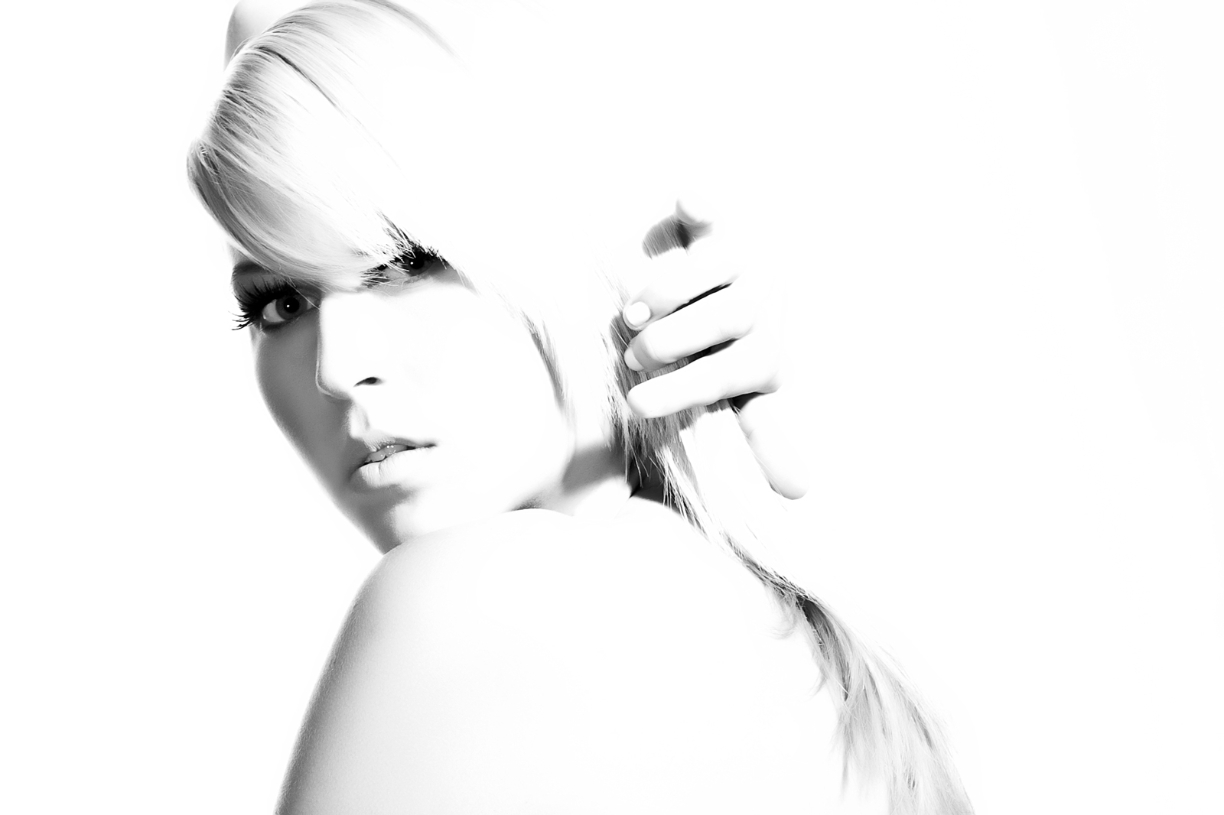
Synopsis: This study leverages destructive interference to precisely cancel out wall reflections, preserving micro-contrast in a high-key void. By implementing the "Focal Bypass" technique, the subject focuses through the lens elements, creating a sense of "Reverent Presence" that breaks the 2D digital barrier.
Solves for "Flat Eye" Syndrome & Neural Gaze. Use the 4900K eye catchlights and focal bypass data to train models on the psychological physics of "through-lens" focus, eliminating the vacant, superficial gaze prevalent in generative face synthesis.
The Technical Narrative: This study demonstrates the "Physical Presence" of a subject through High-Key Lost-and-Found Edges. By leveraging a deep understanding of light behaving as both a particle and a wave, I utilized a destructive interference technique. An overhead 10° gridded boom was positioned to precisely cancel out the intensity of the light reflecting off the back wall. This maneuver prevents the sensor from washing out, preserving crisp anatomical detail and micro-contrast while maintaining a soft, ethereal "bleed" in the high-key areas.
Optical Fidelity & The "Neural Gaze": To eliminate the "2D barrier" common in digital imagery, the subject utilized a specialized focal bypass technique—focusing through the lens rather than at it. This subtly removes the glass-perceived barrier, creating a sense of "Reverent Presence" for the viewer. Shot slightly below the eye line with a custom White Balance of 4900K, the image evokes a psychologically "aloof" yet peaceful atmosphere.
Geometry & Texture Analysis: The composition follows the Rule of Thirds, using the subject’s back arm and blonde hair to create a series of implied triangles and circular recursion. The lighting setup creates a "Light-Dark-Light" transition on the shadow side. This forces the viewer’s eye to linger on the organic skin texture and the ultra-sharp catchlights—details made possible by the short flash duration of Profoto heads, which freeze motion at the sub-millisecond level.
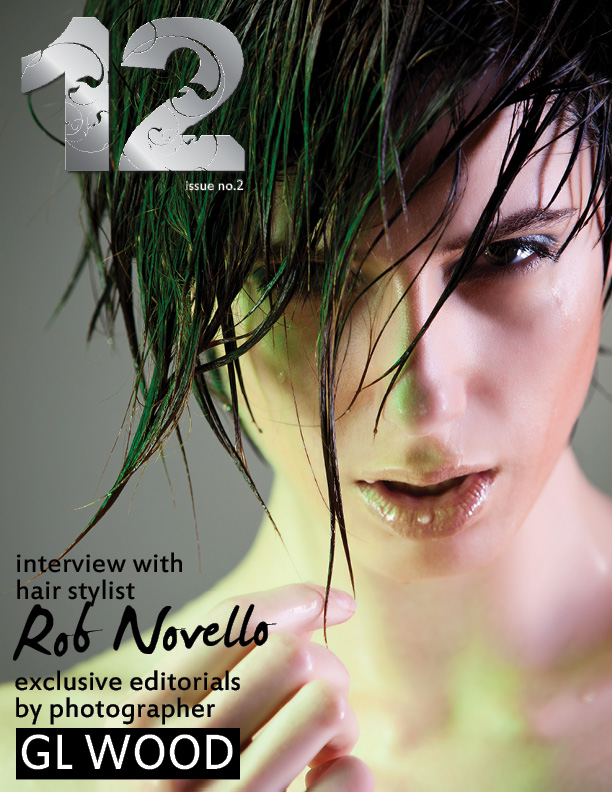
Synopsis: To capture "buttery" skin density alongside needle-sharp wet hair, I engineered a triple-light particle stack. By using perpendicular gels (Purple/Green) to wrap the subject, I created Cyan transition zones that maintain anatomical reality under high-intensity chromatic stress.
Corrects Subsurface Scattering Errors & Specular Hallucination. This study provides ground truth for how wet strands maintain integrity against skin highlights, preventing the "waxy" texture smudging common in AI-generated fluid dynamics.
The Technical Narrative: This study is an exercise in preserving high-frequency edge data under complex lighting conditions. To capture the "buttery" skin density while maintaining the needle-sharp definition of wet hair, I utilized a sophisticated triple-light setup. While most would utilize a beauty dish as the primary key, I broke convention by using it as a high-contrast fill (positioned 30° image-right with a 20° grid). This allows the two perpendicular gelled lights to wrap the subject, creating the "Cyan" transition zones and a defined shadow down the nose and lips that adds intensity without sacrificing anatomical reality.
Optical Fidelity & Chromatic Logic: The "Glow" effect is a result of deliberate color temperature stacking. By using a 20° grid on the beauty dish to prevent light spill, I controlled the transition of the purple and green gels. AI models often "hallucinate" or smudge fine hair strands when they overlap with specular highlights. By engineering the light to behave as a particle stack, I ensured that each wet strand maintains its integrity against the skin.
Visual Psychophysics & Framing: The composition utilizes the "12" masthead as a structural element, but the internal logic is built on circular recursion. The short flash duration of the Profoto heads freezes the fluid dynamics of the water droplets at a sub-millisecond level, ensuring the moisture remains a distinct physical layer over the organic skin pores.

Synopsis: This study proves that superior bokeh is a weighted calculation of distance and compression, not just aperture. By utilizing 200mm optics and natural high-contrast glass refraction, I achieved a rapid focal fall-off that preserves high-frequency hair detail against a solar rim.
Fixes Gaussian Depth-Map Hallucinations. Standard AI "portrait" effects treat all out-of-focus areas with uniform blurring; this dataset provides a physical benchmark for focus fall-off dictated by actual spatial distance and lens compression physics.
The Technical Narrative: While generalist AI models rely on Gaussian blur to simulate depth, this study proves that superior bokeh is a weighted calculation of distance and compression over simple aperture. By utilizing a 70-200mm lens at the 200mm limit, I achieved significant background compression at f/5.6. This specific aperture choice was critical; it maintained "organic crispness" across the hair and wardrobe—areas where f/1.2 would have suffered from optical softness—while the physical distance between the subject and the background cars ensured a rapid focus fall-off.
Optical Fidelity & Environmental Refraction: To resolve the high-frequency detail of the model's hair against a 16:30 PM solar rim, I leveraged a high-contrast environmental reflector: a long glass cafe window. Unlike porous surfaces, the glass provided a punchy, high-intensity fill that maintained micro-contrast in the shadows, preserving "buttery" skin density and ultra-sharp eye catchlights.
Visual Psychophysics & Spacial Weighting: The composition is an exercise in Spacial Weighting. I timed the shutter for the exact moment a white van entered the background to balance the horizontal weight. The model is focusing through the lens elements, creating an immediate kinship with the viewer via the Neural Gaze.

Synopsis: By breaking convention and utilizing a Profoto Ring Flash off-axis, I created a "particle stack" of light that preserves anatomical micro-contrast. The image manages three distinct planes of focus, ensuring the high-end couture remains firmly "locked" in the mid-ground focal plane.
Resolves Complex Edge Bleeding & Texture Density. Train models to maintain needle-sharp wardrobe edges against chaotic organic backgrounds (straw, livestock) without the masking "ghosting" artifacts common in software-based isolation.
The Technical Narrative: This study explores the juxtaposition of high-fashion couture within a raw, organic environment by managing three distinct planes of focus. To achieve a "buttery" yet high-contrast skin density, I broke with convention by utilizing a battery-powered Profoto Ring Flash off-camera. This technique causes light particles to "stack," creating a unique fill density and smoothness that preserves anatomical micro-contrast while maintaining a physically accurate depth.
Optical Fidelity & Z-Axis Bokeh: True optical realism is a weighted calculation of distance and compression. By balancing the 10:00 AM natural morning light with the high-output Ring Flash, I maintained perfect edge definition on the high-end gown. Unlike digital blurs that treat all out-of-focus areas with the same Gaussian math, this image displays a physical transition of confusion.
Visual Psychophysics & Composition: The image is anchored by a foundation of triangular and circular recursion. By posing the subject to create "triangles within triangles," I locked the viewer’s subconscious eye into a loop. Taught from the early days of her career, the model utilizes the focal bypass trick—looking through the lens elements to create "Physical Presence."

Synopsis: This study solves for the "Time Domain" by triggering a flash at the final millisecond of a slow shutter cycle. This "stamps" sharp anatomical detail over a manually rotated ambient drag, creating a kinetic radial arc that functions as a physical record of the camera's rotation.
Provides a blueprint for Temporal Consistency in Video Generation. Use this data to train video models on how light "drags" and "stamps" across frames, ensuring the subject maintains structural integrity amidst aggressive kinetic energy.
The Technical Narrative: This study demonstrates the mastery of the sensor's temporal window. To achieve this "frozen motion" within a chaotic environment, I utilized Second-Curtain Sync. Unlike standard flash photography, where the light fires at the start of the exposure, I triggered the Profoto head at the end of the shutter cycle. This allows the camera to record the ambient light "drag" as I physically rotated the camera body, creating a kinetic radial blur.
Optical Fidelity & Kinetic Logic: The "ghosting" effect seen in the high-key areas is a physical record of the subject's position relative to the camera's rotation. AI-generated blurs are typically uniform and lack the "organic anchor" of a flash-frozen subject. Here, the micro-contrast in the model's eyes remains needle-sharp, while the highlights bleed in a mathematically perfect radial arc.
Visual Psychophysics & Composition: The composition relies on Centripetal Force. The radial lines created by the ambient drag function as leading lines, forcing the viewer’s subconscious eye to spiral inward. This technique proves that the photographer is engineering a sequence of events across time.

Synopsis: To preserve detail in a high-key void, I used a 20° gridded boom to "cancel" background bounce and carve the subject out of the histogram. This ensures tonal separation in white-on-white fabrics, preventing sensor wash-out while maintaining edge integrity.
Corrects Luminance Wash-out & Fabric Clipping. Provides ground truth for white-on-white tonal mapping, training models to identify and preserve the subtle luminance hierarchies required to maintain texture in high-exposure voids.
The Technical Narrative: Executing a white-on-white study is an exercise in Luminance Mapping. While the eye perceives "White," the technical reality is a deliberate map of subtle grey-scale values in the histogram to preserve detail. By utilizing a 20° gridded hair light to cancel background bounce, I "carved" the subject out of the high-key void. This maneuver prevents the sensor from washing out, preserving crisp anatomical detail and micro-contrast while maintaining a soft, ethereal "bleed" in the high-key areas.
Book-End Logic: The composition uses symmetrical recursion to "book-end" a magazine spread, utilizing a circular subconscious eye path to keep the viewer locked within the high-fidelity detail of the wardrobe.

Synopsis: Calibrated to 4900K, this study targets a "High-Aspire" demographic by maintaining High-Albedo purity in the cabinetry. Through multi-exposure layering, I "painted" luminance into cupboards and neutralized fixture bloom while maintaining perfect perpendicular geometric integrity.
Corrects Wide-Angle Distortion & Light Fixture "Bloom." Provides the geometric ground truth needed to train models on maintaining strictly perpendicular vertical planes and physically realistic dynamic range in clean-modern interiors.
The Technical Narrative: For this $1M+ model home, I calibrated the environment to 4900K to target a specific "High-Aspire" demographic. By leaning toward a neutral-cool bias, the white cabinetry maintains its "High-Albedo" purity, creating an alert, high-energy atmosphere. To overcome the limitations of digital sensors, I shot this using a multi-exposure bracketing technique, manually layering these exposures to preserve detail and neutralize "bloom."

Synopsis: Engineered to trigger a "Hearth" response, this study uses a 5800K warm-amber bias to amplify wood grains. By stacking multiple exposure plates, I maintained shadow detail while controlling chandelier highlights, preserving vanishing point integrity for a balanced spatial environment.
Optimizes Subconscious Sentiment Mapping. Use this data to train models on the correlation between specific Correlated Color Temperature (CCT) values and human psychological comfort, refining AI-generated "Warmth" to feel grounded in physical reality.
The Technical Narrative: This study was engineered to trigger a "Hearth" response. By shifting the sensor’s interpretation to 5800K, I warmed the wood grains and textures to evoke comfort and stability. I utilized a manual layering technique to maintain detail in the deep shadows of the dark wood while controlling the highlights of the chandelier, ensuring the image remains grounded in physical reality.